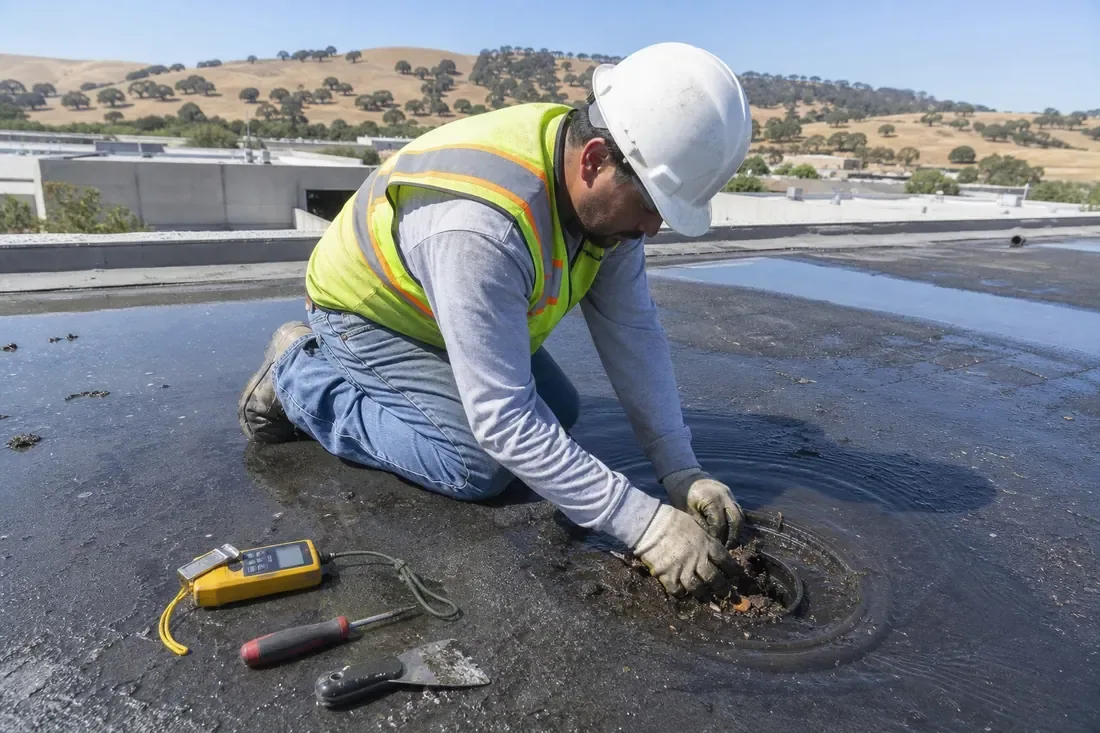
Commercial Roof Membrane Puncture Repair
An unsecured cable clamp with a sharp edge can cut a membrane upstand as equipment moves. The cut needs closure, and the contacting hardware needs correction before the repaired sheet receives the same stress. We examine the clamp position and damaged flashing on the affected roof in New Braunfels, TX. The equipment trade resolves its attachment and movement requirements. The roofing investment then follows the sheet and lower layers that must be rebuilt around that corrected contact.
We repair punctured commercial roof membranes with suitable material and receiving construction. The inspection identifies the sharp contact, sheet identity and affected assembly. A small cut can admit water beneath otherwise usable roofing. We examine that condition before defining the removal boundary. The owner should compare the complete correction, including access to the contact point, with any wider renewal needed where damaged layers extend beyond the visible opening.
Remove the cutting action before closing the sheet
A clamp edge bearing against flashing can damage a fresh repair when equipment shifts or a cable is handled. We examine the contact during the accessible inspection. The responsible trade checks its attachment, clearance and support. Its correction should keep sharp material away from the sheet without transferring load into another vulnerable detail. Moving the contact temporarily may be insufficient if normal service returns it to the same position. The correction should account for expected cable handling and the clearance required when the equipment is opened for maintenance.
The scope for roof correction near equipment connections identifies the roofing work separately from cable or equipment hardware. We coordinate that hardware task before final closure where practical. If its removal exposes another penetration, the new opening also needs a compatible roofing detail. The completed arrangement should leave enough access to inspect the repaired upstand and perform later service without pressing tools against it.
Identify suitable membrane around the cut
A clean puncture through flexible sheet differs from a ragged opening in deteriorated membrane. We examine the edges, surrounding material and older repairs. The selected closure needs useful receiving sheet and preparation suited to its system. Contamination or incompatible patch residue can increase removal. A repair should meet sound material around its entire perimeter, including the vertical side where the clamp made contact.
Repair of an EPDM membrane connection requires its own compatible preparation and materials. A PVC sheet reconstruction uses different methods. We identify the installed roof before specifying either approach. Cutting action at an upstand can also strain its termination. Inspect that connection rather than treating the puncture as a flat patch applied beside an unchecked vertical edge.
Measure the lower-layer effect of the opening
Water through the cut may reach insulation or board below the sheet. We examine accessible edges and open selected areas where lower condition determines retention. Wet or damaged material needs its own replacement quantity. The removal boundary can be larger than the cut because the receiving layers must support the new detail. Suitable material outside that extent may remain if the rebuilt connection can meet it properly.
For replacement beneath a punctured roof sheet, the proposal identifies material depths and the transition to retained construction. A damp surface alone does not locate every damaged lower layer. Physical investigation establishes the rebuilding boundary. Where the cut reaches a wall or curb, that boundary also needs a complete flashing connection. Replacing boards without restoring the vertical detail would leave part of the original entry path open.
Reach the contact point at the requested building
San Marcos includes manufacturing and light-industrial activity along with educational institutions. A requested industrial roof in San Marcos needs examination of its actual equipment approach and contact point. A service platform, cable route or equipment enclosure may restrict preparation at an upstand. We identify what must move and which trade handles it before removing roofing. The access allowance permits complete preparation rather than a patch short of the damaged edge.
Live Oak Crossing and Gateway Plaza contribute to Live Oak's retail development. At a requested retail property there, an equipment-side cut can require protection above occupied space while the receiving layers are examined. We identify the affected operation and practical material route. The repair should reach the actual puncture and adjoining termination even where that location is less convenient than an open portion of field roofing.
Separate other open connections from the puncture
A nearby seam or wall transition can admit water independently of the cut. We inspect adjoining details where their condition warrants attention. The puncture repair needs a defined closure, and a separate defect needs another correction. Their removal boundaries may meet if damaged layers connect beneath them. The owner should see that relationship in the allowance rather than receiving one unmeasured surface treatment for several different conditions.
Rebuilding an open membrane seam and correcting a damaged flashing transition require their own receiving-material checks. If water remains trapped after those tasks, the retained-water condition needs drainage examination. Each repair should contribute to a usable completed assembly. Adding patches without assessing their overlaps and water path can create another obstruction or incompatible connection.
Restore service access without repeating the damage
The finished patch or reconstructed upstand needs inspection at its edges and termination. We check the visible connection using methods appropriate to the material. The corrected cable clamp should remain clear of the repaired membrane under the equipment arrangement accepted by its responsible trade. Any layers opened below the sheet need suitable reconstruction. Completion photographs identify the contact correction and roofing boundary as separate but coordinated tasks.
For ongoing care of the repaired roof area, identify the equipment approach and vulnerable vertical details. Later cable changes can reintroduce sharp contact if they alter hardware position. Review those changes before service ends. Suitable protection and a usable path can reduce incidental contact, but they must not cover a detail that still needs inspection or block drainage. The next repair decision should follow a new physical condition rather than repeating closure beneath unchanged cutting hardware.
Commercial Roofing Questions
Can you patch the cut before the cable clamp is corrected?
Temporary protection may be needed while the responsible trade resolves the hardware. The permanent repair should be coordinated with that correction. We examine whether contact continues and identify the material required for closure. A finished patch exposed to the same sharp edge can be damaged again, leaving its receiving construction vulnerable despite new membrane.
How large should the puncture repair be?
Establish a boundary of suitable sheet and lower layers around the opening. The patch needs compatible receiving material on all sides. Wet board or deterioration can extend the reconstruction beyond the visible cut. We identify that extent before proposing the quantity. Dimensions should follow the completed detail's requirements rather than the size of the sharp object alone.
Does equipment need moving for a small upstand cut?
Restricted preparation or inspection access may make movement necessary. We examine the position and coordinate the responsible equipment task. If the cut and termination are fully accessible, another arrangement may suffice. Include required disconnection, lifting and protection in the allowance before opening the roofing, so the permanent detail can be completed instead of being left partly concealed.
What should a later technician check near the repair?
Keep sharp hardware, tools and displaced supports away from the reconstructed sheet. Examine the accepted contact clearance when cable or equipment work changes it. Report any visible cut, loose termination or damaged protection for roof assessment. The material and repair boundary should stay with the building's history so a new condition can be compared with the completed correction.

Commercial Roof Membrane Puncture Repair