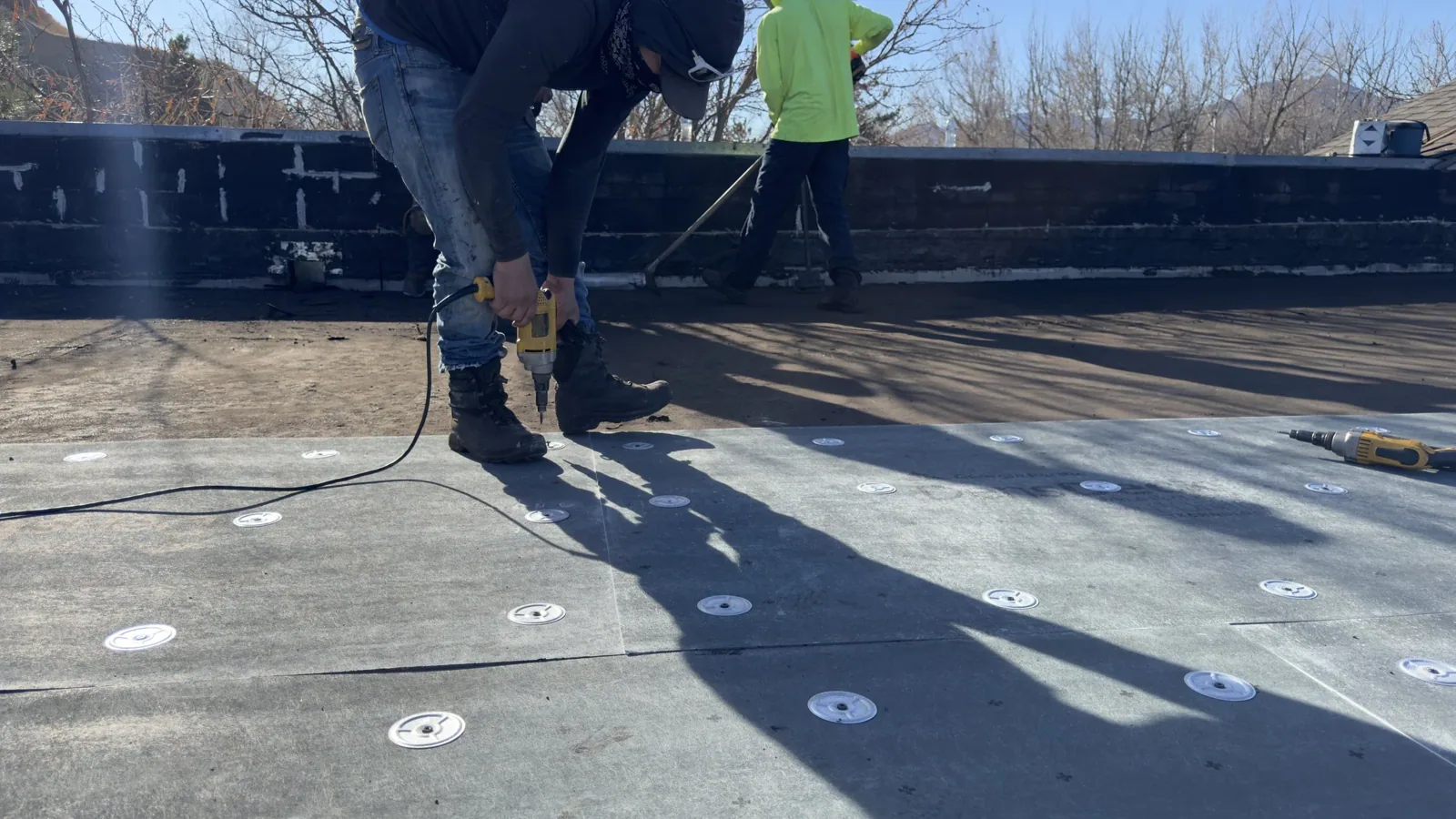
Commercial Roof Seam Failure Repair
An incomplete weld where overlapping sheets form a T-junction can leave a small water path beneath an otherwise attached seam. The crossing needs closer examination before the owner funds another broad surface treatment. We check the junction, adjoining welds and sheet condition on the affected commercial roof in New Braunfels, TX. A local compatible correction may be useful if suitable membrane and receiving layers remain. The measured repair must close the actual crossing, not only its visible outer edge.
We repair welded, adhered and other membrane connections according to the installed material. An opened seam needs identification of both the sheet and the reason its connection is unsuitable. Contamination, poor preparation, movement and damaged receiving layers lead to different work quantities. We examine the affected area before selecting a closure. The owner receives a reconstruction boundary that distinguishes usable adjoining membrane from the sheet or lower layers that need replacement.
Examine the crossing rather than only the straight seam
A sheet thickness change at a T-junction can leave a channel if the assembly's required detail is incomplete. We examine the accessible seam with a suitable checking method and identify its material requirements. The crossing may need preparation and a compatible supplemental detail. If damaged or contaminated sheet cannot receive that detail, removal extends to material that can. Reheating an unsuitable surface should not substitute for establishing a workable repair edge.
A TPO sheet junction needs material-specific preparation and welding conditions. A PVC roof seam also requires compatible sheet and a properly formed connection. The appearance of one system should not determine the repair selected for another. We examine older patches near the crossing because they may limit preparation or require removal before the replacement detail can reach useful membrane.
Check adjoining seams before defining the opening
A failed junction can remain isolated, while a longer seam may contain other incomplete areas. We examine accessible adjoining lengths and changes in direction. The receiving sheet's condition helps determine whether compatible local rebuilding is practical. A recurring failure pattern may justify investigation farther along the connection. The scope should identify that examination and its findings before recommending replacement of a continuous strip or a wider field.
An adjacent cut through the membrane needs its own defect boundary. A loose termination at nearby flashing can provide another entry path. We inspect those interfaces where the visible condition directs attention there. Repairing one seam will not reconstruct another damaged component. The owner needs a complete allowance for each affected connection and a clear description of what remains outside the work.
Locate wet or unstable material beneath the separation
An open seam can admit water between roof layers. We inspect lower material where that condition affects the receiving construction. Focused openings identify insulation, cover board and support beneath the affected sheet. Wet or broken board needs a measured removal boundary. The new seam detail should lie over suitable material. A bonded patch above damaged board would leave the receiving condition unchanged even if its surface weld appears continuous.
Replacement of damaged seam-supporting roof layers may extend beyond the visible split. We examine material near that boundary and rebuild the opening with compatible transitions. Different thicknesses need a detail that avoids an unsupported ridge or abrupt sheet strain. The repair quantity should state the affected layer depths and the sheet needed to close them. That lets the owner compare actual reconstruction rather than patch dimensions alone.
Assess access at the requested industrial property
Equipment and handling positions may limit access to a junction. We inspect those positions before releasing repair. Moving or temporarily disconnecting an obstruction needs the responsible trade and an allowance where it is required for complete reconstruction.
Main Street is the setting for Cibolo's older commercial district. A requested building in Cibolo can need different handling from an industrial property near FM 1101. We identify its occupied spaces, roof approach and receiving assembly. The work release must let the repair reach the useful sheet boundary. An easier access position should not dictate a smaller closure that leaves the failed seam or damaged board outside the completed work.
Prepare the repair under suitable installation conditions
The sheet surface must be clean and suitable for the selected connection. Preparation follows the material requirements, including treatment of residue and existing repairs. Moisture at the seam affects the work and may require another release. We examine the proposed receiving surface before closing the opening. Suitable trial checks can help establish installation settings for a welded repair. The completed seam still needs inspection at the actual work area.
Where roof reconstruction proceeds above occupied space, handling and noise restrictions may narrow the daily release. We plan a complete weather-resistant stopping point. The work boundary should include enough access to finish the junction and inspect its adjoining edges. If another trade must move equipment first, coordinate that task before removing roofing. The repair should not remain dependent on an undefined later visit to reach its concealed side.
Compare seam rebuilding with the remaining field condition
A suitable field can receive a focused seam repair if the reconstructed connection meets the assembly requirements. Broader sheet deterioration or recurring failed seams may support another renewal. We inspect the construction between defects before making that recommendation. Removal and replacement of a wider membrane area should include its receiving layers and perimeter transitions. The wider option needs more than a new surface covering the existing incomplete connections.
A photographed seam and field assessment identifies the repair completed and the remaining defect, if any. Completion checks should reach the T-junction and adjoining repair edges. Keep the membrane identity and reconstructed boundary with the roof history. Later service work can disturb a seam if equipment is dragged across it. Identify vulnerable access areas so the restored connection remains reachable for inspection and appropriately protected during that work.
Garden Ridge borders Schertz to the south. At the roof, inspect seams, laps and terminations to see whether water has moved beyond the visible split.
Commercial Roofing Questions
Can you repair an incomplete T-junction without removing the long seam?
Examine the crossing and adjoining connection first. Suitable membrane may permit a compatible local correction. Contamination, damaged sheet or wider incomplete bonding can require more removal. We identify the receiving edge and needed junction detail. The repair should close the full water path while retaining only material that can support the completed connection.
Why would a small seam opening need board replacement?
Water entering through the opening can damage lower layers beyond the visible seam. We investigate where that condition changes reconstruction. Wet or fractured board is measured separately from the sheet closure. The new connection needs suitable support, so patching the outer surface alone may leave work unresolved beneath it.
Should every older patch near an open seam be removed?
Its material and condition determine whether it can remain. We examine compatibility, bond and the surface available for the new connection. An unsuitable patch or residue may need removal to reach useful sheet. Sound material outside the reconstruction boundary can stay where the assembly permits. The proposal identifies that difference before the work opens the field.
What confirms that the repaired seam is ready for handover?
Inspect the completed connection using methods suitable for its material. Check the junction, edges and transitions after installation. The restored lower layers and receiving sheet should match the agreed construction. Completion photographs identify the work boundary. Record any separate defect still needing correction so the handover distinguishes the finished seam from the remaining roof investment.

Commercial Roof Seam Failure Repair