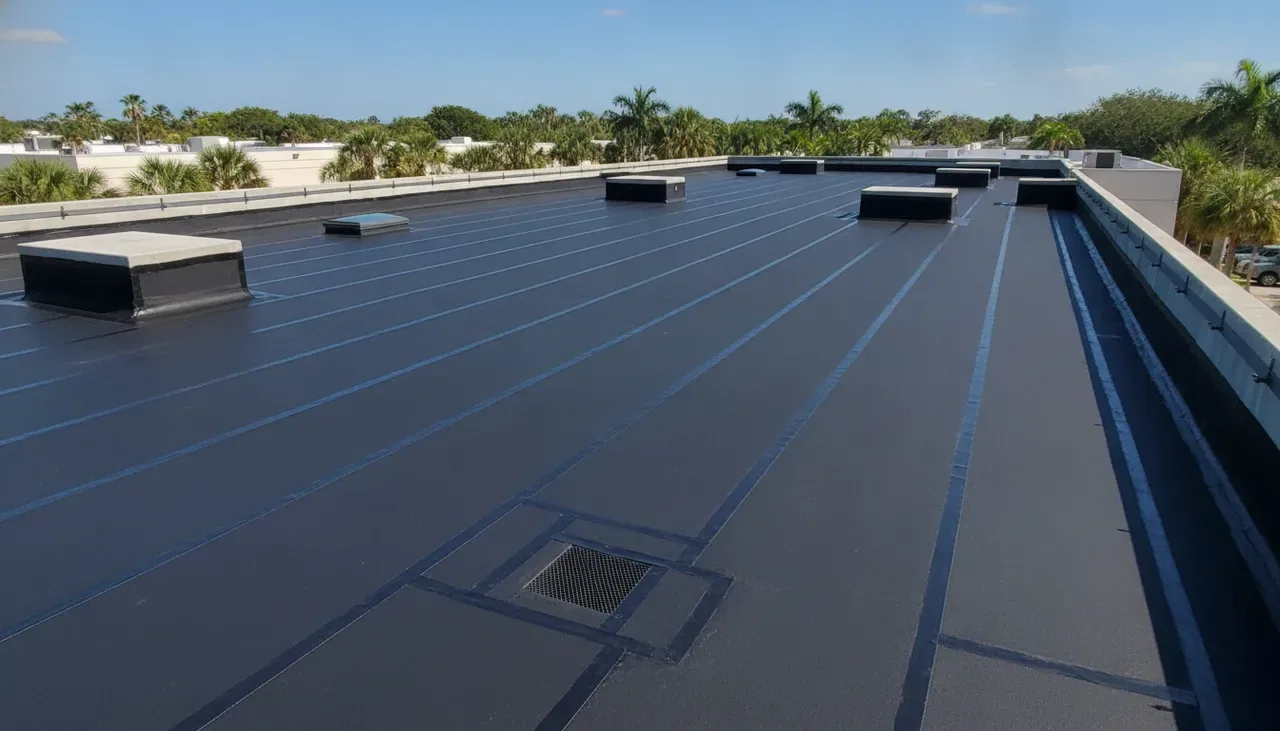
Holcim Elevate Commercial Roofing
A new blister beside an older coating changes what can be retained. The visible surface may be from a later repair, not the original Holcim Elevate membrane. We inspect the affected section in New Braunfels, TX, check the layers and attachment, and define the material that can remain. The label guides the records review, but field conditions decide whether the assembly is dry, accepts a coating, or can support another layer.
Our scope begins with a roof walk, not a product swap. We identify field sheet, flashing, edges and prior patches. Where the assembly is not clear, we mark what needs confirmation. Hot, humid Comal County summers make the actual surface and substrate conditions part of the work release. The owner receives a measured correction or a documented comparison of broader renewal options, with assumptions separated from verified observations.
Separate membrane, cover board and coating
Holcim Elevate commercial roofing materials cover more than one assembly type. A roof record may identify a TPO or EPDM membrane, insulation, cover board, metal accessory or a later restoration layer. We do not treat those materials as interchangeable. The repair method depends on the installed sheet and surface, the condition below it, and the detail being rebuilt. We verify the assembly from labels, drawings, exposed edges and repair records before describing a system as confirmed.
A coating can change how a later patch will bond. So can dirt, oxidation, prior cleaner or a repair compound that was not part of the original specification. We inspect a small area where needed, then state whether a compatible weld, adhesive or liquid flashing detail is available. If the records indicate a different brand or a mixed roof, we compare the Sika Sarnafil system record or the Johns Manville assembly only where the physical roof supports that comparison.
Follow the path from the wet interior
A leak report provides a starting location, not a cut line. We map likely water travel from the affected room toward penetrations, laps, drains and perimeter details. Interior discoloration shows where water surfaced; the roof-side breach may be elsewhere, so we test suspect paths before setting removal limits. We line up the interior report with drainage paths and repair records, then check each suspected entry point from the roof. The inspection notes the failed detail, the adjoining material and any area where moisture evidence calls for a closer look.
When a membrane is lifted, we record the insulation and cover board condition before closing the opening. If a moisture survey shows a broader pattern, the owner can decide whether to verify it with selective cuts. We can document those results in a roof condition report that separates measured damage from the remaining uncertainty. An active leak repair can then be priced as a local correction, with a defined boundary instead of an allowance that assumes every hidden layer is wet.
Set the field plan for New Braunfels operations
Local roof work can touch different schedules and access conditions. A manufacturing and research facility on Kohlenberg Road has a distinct operations context from shops and restaurants in the Gruene Historic District. Those public facts do not identify a particular roof system. A manufacturing property near FM 1101 calls for its own receiving route and equipment restrictions; a Gruene Historic District repair may need different pedestrian protection. We confirm the actual building, work area, delivery route and release contact before scheduling a crew. The repair plan follows the actual owner's operating needs. On arrival, the crew checks the substrate and surface again; an earlier forecast cannot establish installation readiness.
Construction inside city limits goes through Building Safety for permit processing and inspections. We confirm the project path before setting the roof release date. With San Marcos nineteen miles northeast, dispatch can be planned regionally, but only the property controls the receiving entrance and roof access. Hot and humid weather also affects handling and preparation. The crew checks the actual roof for moisture and surface readiness before installing material, then follows the selected manufacturer's installation requirements. A roof visit in Gruene Historic District may require additional pedestrian and tenant protection around the work area.
Compare repair, restoration and new assembly
A local patch can preserve an otherwise serviceable roof. A restoration may address a larger field when the membrane remains stable and the proposed coating is compatible. Replacement is the stronger option when the roof has widespread wet insulation, failing attachment or details that cannot be reliably rebuilt over the retained assembly. We measure each option separately. The quantity includes sheet, flashing, edge metal, insulation and cover board, plus the access, protection, disposal and trade work needed to complete the chosen scope.
Recovery also depends on the existing layers and the assembly's capacity. We check drainage, terminations and attachment before treating the old roof as a suitable base. The owner can compare a defined roof coating restoration with a recover overlay or full removal. No option is a shortcut around wet material or a weak edge. The decision record should show what stays, what is removed, and the inspection finding that would widen the work.
Record the system after the correction
At completion, we inspect welds or bonded edges, corners, penetrations, drains and transitions around the repair. Photographs show the location before and after work. The closeout names the material installed and records any lower-layer repair, retained condition or access limit. A clear record lets a facilities lead compare the next inspection with the same area and avoid treating an old patch as evidence of a new failure.
For equipment areas, we coordinate the service trade's return and confirm that the roof detail is not covered by a new support or line set. For occupied buildings, we remove temporary protection and confirm the agreed route is open. Keep drawings, product submittals, repair records and inspection dates with the building file. If the next decision is capital renewal, a replacement plan can use the measured boundary and the retained-layer notes rather than starting from a generic manufacturer description.
Commercial Roofing Questions
Does the manufacturer name prove that every roof area uses the same membrane?
No. Additions, repairs and coatings can create a mixed assembly. We identify each roof section from records and visible materials. If an area is uncertain, the report names it as unconfirmed and identifies the sample, exposed edge or manufacturer review needed before a compatible repair is selected.
When can a coated membrane receive another coating?
Compatibility is a condition to verify, not a decision from the brand name alone. We inspect coating type, adhesion, surface preparation, trapped moisture and the underlying sheet. A small test or system guidance may be needed. The scope should define preparation and the area included before the owner funds a restoration.
What changes the price of a Holcim Elevate repair?
Measured membrane and flashing quantities set the base scope. Access, lift needs, equipment movement, substrate replacement, occupied-area protection, disposal and permit review can change time and cost. We identify which quantities are visible and which require a selective opening so the owner can compare like-for-like options.
Can a recover keep the current Holcim roof assembly in place?
Recovery may retain sound, dry layers when attachment, drainage, structure and edge details support the added roof. We inspect those conditions first. If moisture or unstable material is found, it needs a measured removal quantity. The recover scope states the assumptions and the field condition that would change it.
How do you coordinate work near production or customers?
We name the work area, access contact, equipment limits, delivery route and return-to-service time before mobilizing. Manufacturing schedules and customer paths require different controls. The crew can phase the work by area when the roof and weather allow, and the closeout records any remaining restriction.

Holcim Elevate Commercial Roofing